Updated: October 2026
Affiliate Disclosure: This page contains affiliate links. If you purchase through my links, I may earn a commission at no extra cost to you. As an Amazon Associate I earn from qualifying purchases. I only share products I use myself or that are closest to what I use.
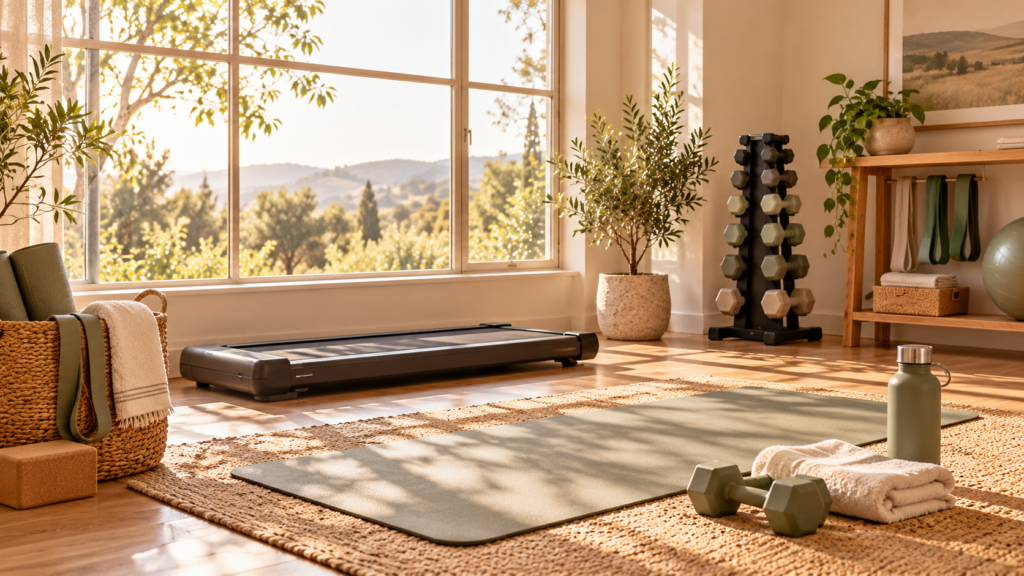
If you’re looking for a workout plan for women over 50 that actually fits into your busy life, you’re in the right place.
I’m going to be completely honest with you: I need this plan as much as you do.
I’ve spent the past few weeks so hyperfocused on building my business that by the time my husband gets home from work, I’m completely tapped out. There’s dinner to make, and then I’m crawling into bed. The idea of working out feels out of reach.
But here’s what I know about our bodies after 50: they NEED movement. Not punishing workouts. Not complicated gym routines. Just consistent, intentional movement that builds strength and supports our bones, joints, and mental health.
So I’m making myself a promise this January, and I’m inviting you to make it with me: 30 minutes a day. That’s it.
This is the plan I’m following. It’s gentle, progressive, and starts exactly where we are: sedentary, stressed, and ready for a change.
If you have a health condition, joint issues, or haven’t been active in a while, check with your doctor before starting a new workout plan.
Why Women Over 50 Need a Different Approach to Fitness
Let me share some uncomfortable truths about what happens to our bodies as we age:
- Muscle loss adds up: Research suggests adults can lose roughly 3–8% of muscle mass per decade after 30, and the loss tends to speed up with age.
- Bone density decreases: Women can lose up to 20% of their bone density in the five to seven years after menopause, according to the Bone Health and Osteoporosis Foundation.
- Body composition shifts: Losing muscle can make weight management harder. (Interestingly, a large 2021 study found metabolism itself stays fairly stable from 20 to 60, so muscle matters even more.)
- Joints get stiffer: Which can lead to more aches and less mobility.
- Balance declines: Which raises the risk of falls.
But here’s the empowering truth: strength training and consistent movement can slow, and in some cases improve, many of these changes. According to the CDC, regular physical activity can:
- Lower the risk of heart disease, stroke, type 2 diabetes, and some cancers
- Build stronger bones and muscles
- Improve balance and reduce the risk of falls
- Improve mood, sleep, and brain health
A large Cochrane research review also found that exercise programs reduced the rate of falls in older adults by about 23%.
We’re not trying to look 25 again. We’re trying to feel strong, capable, and energized in the bodies we have right now.
And we don’t need a gym membership or hours of free time to make it happen.
The Complete 12-Week Workout Plan for Women Over 50
This isn’t about transformation photos or extreme results. It’s about building a sustainable fitness foundation that makes you feel stronger by summer, and keeps you moving for decades to come.
Phase 1: Weeks 1–4 – Build Your Walking Foundation
This plan starts simple: walking.
Why walking? Walking is a low-impact cardio exercise that:
- Strengthens your heart without stressing your joints
- Improves circulation and endurance
- Releases endorphins (natural mood boosters)
- Builds the habit of daily movement
- Requires no equipment or learning curve
Your Week-by-Week Walking Plan
- Week 1: 15 minutes, 3–4 times per week
- Week 2: 20 minutes, 4–5 times per week
- Week 3: 25 minutes, 5 times per week
- Week 4: 30 minutes, 5–6 times per week
Walking Tips
- Start at a comfortable pace. You should be able to hold a conversation.
- Gradually increase your speed as your fitness improves.
- Focus on good posture: shoulders back, core engaged.
- Work toward at least 150 minutes of moderate activity per week, the amount recommended by the American Heart Association and the CDC.
The Right Footwear Matters
Don’t let “I don’t have the right shoes” stop you from starting. But good footwear can make walking more comfortable for your feet and joints.
I wear Skechers Women’s Slip-Ins because they have great arch support (which I need, since I’m flat-footed), no laces to fuss with, and they’re much more affordable than premium brands at $150+.

Phase 2: Weeks 5–8 – Add Resistance Band Training
Once walking feels comfortable, it’s time to add strength training. Resistance bands are a great fit because they’re:
- Joint-friendly: low-impact with controlled resistance
- Versatile: they work all the major muscle groups
- Affordable: about $15–30 for a good set
- Portable: use them anywhere, anytime
- Progressive: multiple resistance levels as you get stronger
Your Strength Routine
Keep walking 3–4 times per week, and add 2–3 strength sessions of 15–20 minutes each. Alternate between two simple workouts. Each one works your whole body.
Do 2–3 sets of each move, resting 30–60 seconds between sets. The free printable below includes simple drawings of every move.
Workout A
- Squats (legs, glutes, core): Stand on the band and hold the ends at your shoulders. Squat down as if sitting in a chair, then stand back up. 2–3 sets of 10–12 reps.
- Chest Press (chest, shoulders, arms): Wrap the band behind your back and hold the ends. Press forward, then return slowly. 2–3 sets of 10–12 reps.
- Rows (back, posture muscles): Sit with your legs extended and the band around your feet. Pull the ends toward your ribs, squeezing your shoulder blades. 2–3 sets of 10–12 reps.
- Glute Bridges (glutes, lower back, hips): Lie on your back with a loop band just above your knees. Lift your hips while gently pressing your knees outward, then lower. 2–3 sets of 12–15 reps.
- Dead Bugs (core, back support, no equipment): Lie on your back with arms reaching up and knees bent over your hips. Slowly lower one arm overhead and the opposite leg toward the floor, keeping your lower back pressed down. Return and switch sides. 2–3 sets of 6–8 per side.
Workout B
- Romanian Deadlifts (hamstrings, glutes, back): Stand on the band and hold the ends in front of your thighs. Push your hips back with a slight knee bend and a flat back, then stand tall. 2–3 sets of 10–12 reps.
- Overhead Press (shoulders, arms): Stand on the band and hold the ends at your shoulders. Press straight up, then lower slowly. 2–3 sets of 10–12 reps.
- Bicep Curls (arms): Stand on the band and hold the ends at your sides. Bend your elbows to curl your hands toward your shoulders, then lower. 2–3 sets of 10–12 reps.
- Lateral Walks (hip stability, balance): Place a loop band just above your knees or around your ankles. With knees slightly bent, step sideways, keeping tension on the band. 2 sets of 10 steps each direction.
- Bird Dogs (core, balance, back, no equipment): On hands and knees, slowly reach one arm forward and the opposite leg back, keeping your back flat and hips level. Pause, return, and switch sides. 2–3 sets of 6–8 per side.
Form is everything. Move slowly and with control. If you feel sharp pain (not just muscle fatigue), stop. For video demonstrations, search YouTube for the exercise name.
Glute bridges and lateral walks work best with a small loop band (sometimes called a mini band). The other band moves work with a long band or a band with handles.
A set with multiple resistance levels lets you progress as you get stronger. This is the set I have:

- Natural Latex
- Made in the USA or Imported
- 【Professional-Grade Rubber Material, Non-Slip & Durable】 Crafted from high-quality elastic Rubber material, these resist…
Phase 3: Weeks 9–12 – Progress to Light Weights (Optional)
By week 9, you’ve been moving consistently for two months. You may be feeling stronger, with more energy and better sleep.
Now you have choices:
Option 1: Transition to light dumbbells
If you’re ready for more challenge, swap the bands for light dumbbells. Many people start with 5–10 lb. You’ll keep doing Workout A and Workout B, with a few small changes:
- Squats: hold one dumbbell upright at your chest (a goblet squat).
- Chest press: lie on the floor with knees bent and press the dumbbells straight up (a floor press).
- Rows: hinge forward at the hips with a flat back, one hand on a chair if you like, and pull the dumbbell toward your ribs.
- Glute bridges: rest one dumbbell across your hips.
- Romanian deadlifts, overhead press, and bicep curls: same movements, holding dumbbells instead of the band.
- Lateral walks, dead bugs, and bird dogs: no change. Keep using the band or your body weight.
Strength sessions in weeks 9–12 take about 20–25 minutes.
Benefits of strength training for women over 50:
- Helps maintain bone density
- Builds and maintains muscle
- Improves strength for everyday activities
- Supports balance and coordination
Option 2: Continue with resistance bands
Resistance bands can take you a long way. If you’re seeing progress and feeling good, there’s no rush to add weights. Simply:
- Move up to a heavier resistance level
- Add more reps (12–15 instead of 10–12)
- Slow down your tempo
Option 3: Combine both
Walk 3 days, use bands 2 days, and light weights 1 day. Variety challenges your body in different ways and prevents boredom.
Whichever option you choose, consistency matters more than intensity.
This set is the closest to the dumbbells I use but there are tons of options on Amazon to fit your needs:

- COMPLETE 300 LB DUMBBELL SET WITH RACK – Includes a pair of 10-pound, 20-pound, 30-pound, 40-pound, and 50-pound rubber …
- RUBBER HEX DUMBBELLS FOR DURABILITY & STABILITY – Protective coating helps reduce noise and floor damage while the anti-…
- SPACE-SAVING VERTICAL RACK – Compact vertical storage keeps weights accessible and off the floor, ideal for home gyms, g…
Nutrition: What Works for Me
What you eat matters as much as how you move. But you don’t need to overhaul everything overnight.
For me, eating plenty of protein (eggs, chicken, and fish) and lots of vegetables, while avoiding bread and processed foods, keeps my energy steady and supports my workouts. (I share more about how I eat in Insulin Resistance in Midlife: What I Learned and What Helped Me.)
The Supplements I Take
I keep my supplement routine simple. Two I take every day:
- Sports Research Vegan Omega-3: part of my routine for joint health. It’s third-party tested, which matters to me.
- Magnesium glycinate at night: it helps me sleep.
I also take D3/K2 and a few others. You can see everything I use on my Supplements I Use list.
Everyone’s needs are different, so talk with your doctor before starting supplements, especially if you take medications. Your doctor can also check things like your vitamin D level to see what you actually need.
For more on what has helped my joints, see Lifestyle Habits That Helped Ease My Joint Pain and Inflammation.
Sample Weekly Schedule
Weeks 1–4 (Walking Phase):
- Monday: 15–30 min walk
- Tuesday: Rest or gentle stretching
- Wednesday: 15–30 min walk
- Thursday: 15–30 min walk
- Friday: Rest
- Saturday: 15–30 min walk
- Sunday: Rest or leisure walk
Weeks 5–8 (Walking + Bands):
- Monday: 30 min walk
- Tuesday: 20 min resistance band workout
- Wednesday: 30 min walk
- Thursday: 20 min resistance band workout
- Friday: Rest
- Saturday: 30 min walk
- Sunday: Rest or light yoga
Weeks 9–12 (Full Routine):
- Monday: 30 min walk
- Tuesday: 25 min resistance or weight training
- Wednesday: 30 min walk
- Thursday: 25 min resistance or weight training
- Friday: Rest or gentle yoga
- Saturday: 30 min walk
- Sunday: Rest
Your 30-Minute Daily Investment
Here’s what I’m asking of you (and myself): 30 minutes a day. Not 90-minute gym sessions. Not complicated meal prep routines. Not waking up at 5 AM for boot camp. Just 30 minutes of intentional movement.
Because here’s the truth we don’t talk about enough: we’ve been putting ourselves last for decades. We’ve built careers, raised families, managed households, and sacrificed our own health and well-being in the process.
This is the year we reclaim 30 minutes for ourselves. Not because we want to fit into smaller jeans (though that might happen). Not because we’re trying to prove anything to anyone.
But because we deserve to feel strong, capable, and energized in our own bodies.
Because we want to travel without getting winded. Because we want to move without back pain. Because we want to chase our dreams with the physical stamina to back them up.
This plan isn’t about transformation. It’s about empowerment.
Start Your Workout Plan Today
Don’t wait until Monday. Don’t wait until you have perfect gear or the perfect plan mapped out.
Put on whatever shoes you have right now and walk around your block. Today. Tomorrow, do it again.
That’s how sustainable change begins. One small step. One day at a time.
If you’d like a free printable version of this 12-week plan with built-in trackers, you can download.
Let’s do this together. You’ve got this, and I’m right here with you.
SHARE WITH A FRIEND: Know a woman over 50 who needs this? Send her this post and start together.
Disclaimer: The information shared in this post is based on my personal experience and is intended for educational and informational purposes only. It isn’t medical or fitness advice. Please consult your healthcare provider before making changes to your exercise or health routine, especially if you have a medical condition or take medications.
Related Posts You Might Like
- Lifestyle Habits That Helped Ease My Joint Pain and Inflammation
- The Truth About the Midlife Transition (and Why It Feels So Heavy)
- Insulin Resistance in Midlife: What I Learned and What Helped Me
Common Questions
Q: I haven’t exercised in years. Is it too late to start? A: Absolutely not. Research shows that women in their 60s, 70s, and even 80s can build muscle and strength with consistent training. Start where you are, not where you think you should be, and check with your doctor first if you have health concerns.
Q: What if I have joint pain or arthritis? A: Low-impact exercise like walking and resistance bands is often easier on the joints. But please talk with your doctor or a physical therapist before starting any new workout plan, especially if you have an existing condition.
Q: How long before I see results? A: Everyone is different. Many people notice more energy within a few weeks. Strength and physical changes usually take longer, often a couple of months of consistent effort. Try to focus on how you feel, not just what you see.
Q: Do I need to count calories or follow a specific diet? A: Not necessarily. I’d focus on building the exercise habit first. Once that feels solid, you can look at nutrition. For me, more protein and vegetables made the biggest difference. A doctor or registered dietitian can help you figure out what’s right for you.
Q: What if I miss a few days? A: Life happens. Don’t let a few missed days derail your entire plan. Just pick up where you left off. Consistency over time matters more than perfection.
Q: Can I do this workout plan if I’m overweight? A: Yes! This plan is designed to be accessible at any fitness level or weight. Walking and resistance bands are low-impact and easy to modify. Check with your doctor if you have any health concerns, and focus on how you feel, not the number on the scale.